

Second 'mini moon' to begin orbiting Earth this autumn
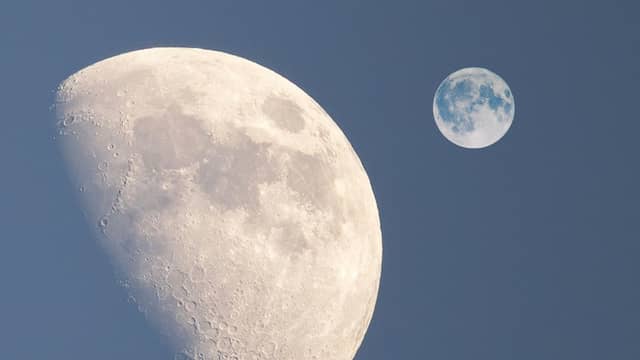

Earth's gravitaional pull will trap a small asteroid in orbit around the planet for nearly two months
Earth is set to gain a second 'mini moon' for a few weeks this autumn.
Research published by the American Astronomical Society shows that an small asteroid, roughly the size of a bus, will be captured by Earth’s gravitational pull and orbit the planet for about two months.
According to the paper authored by Carlos and Raúl de la Fuente Marcos of the Universidad Complutense de Madrid; "Earth can regularly capture asteroids from the Near-Earth object (NEO) population and pull them into orbit, making them mini-moons."
The asteroid, known as 2024 PT5, is set to orbit Earth from September 29 until November 25, before returning to its home in an asteroid belt revolving around the sun.
“The object that is going to pay us a visit belongs to the Arjuna asteroid belt, a secondary asteroid belt made of space rocks that follow orbits very similar to that of Earth,” Carlos de la Fuente Marcos, a professor at Universidad Complutense de Madrid and the lead author of the research, told Space.com.
"Objects in the Arjuna asteroid belt are part of the near-Earth object population of asteroids and comets."
Some of these objects in the Arjuna asteroid belt can approach Earth at a close range of around 2.8 million miles (4.5 million km) and at low velocities of around 2,200 miles per hour (3,540 km/h), Professor Marcos explained.
"Under these conditions, the geocentric energy of the object may grow negative, and the object may become a temporary moon of Earth. This particular object will undergo this process starting next week and for about two months," he added.
"It will not follow a full orbit around Earth.
"You may say that if a true satellite [like the Moon] is like a customer buying goods inside a store, objects like 2024 PT5 are window shoppers."
Unfortunately for stargazers, 2024 PT5 will be "too small and dim for typical amateur telescopes and binoculars", but will be "well within the brightness range of typical telescopes used by professional astronomers," Prof Marcos said.
He and his team plan to carry out "spectroscopic and photometric observations" of 2024 PT5 to better understand its nature during its visit to our orbit.