

Budget 2021 to support economy while prioritising Covid-19 response and Brexit
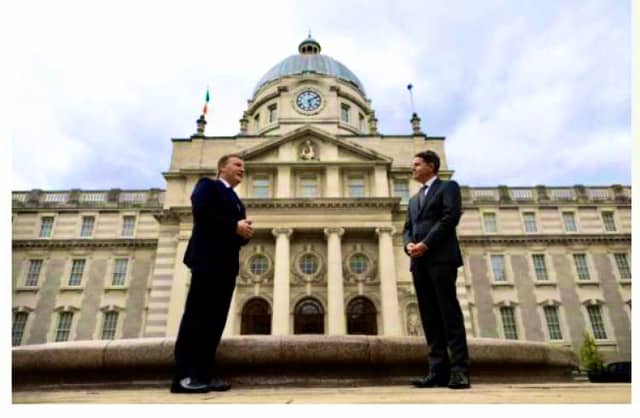


Today's Budget 2021 will expected to focus on providing further support to the economy while decisions will also prioritise management of the Covid crisis and Brexit.
Any further measures will be targeted at the three priorities in the Programme for Government – health, housing and climate change.
The Government is expected to base the Budget on the assumption of a disorderly Brexit.
There will be no broad based increases in income taxation.
Budget 2021 will also target an improvement in the headline fiscal position, while allowing deficit-financed spending to continue in the short-term.
The government will publish a medium-term plan in Spring outlining how the government will balance the budget, when there is more certainty.
As an overall strategy, the government will balance the need to continue to provide counter-cyclical support to the economy while ensuring that the public finances remain on a sustainable path.
It was confirmed that the Budget will be based on the following assumptions: from the beginning of next year, bilateral trade between the UK and the EU will be on World Trade Organisation terms and that, in the absence of a vaccine, the economy – and broader society – must co-exist with the virus
Furthermore, it was agreed that:
a. Broad-based increases in taxation would be counter-productive at this stage of the cycle;
b. As set out in the Programme for Government, in Budget 2021 there will be no change to income tax credits or bands;
c. Budget 2021 will prioritise a continued response to the COVID-19 crisis rather than ‘normal’ budgetary adjustments;
d. Preserving and maintaining existing levels of service will be the priority;
e. As per the Programme for Government, the sectoral priorities will be Health, Housing and Climate change;
f. As set out in the Programme for Government, a ‘Recovery Fund’ will be established and we will provide the details and mechanics of this on Budget day. This Fund will be needed to ensure continued support for the economy. Decisions with respect to the Fund will be made across the year.
The Government believes that given elevated uncertainty, the economic and budgetary projections which underpin Budget 2021 will cover the short-term, and will not extend beyond 2021.
Medium-term projections will, instead, be set out in the Stability Programme Update, which will also set out a medium-term trajectory towards a balanced budget. This will be published in the spring, in line with the normal timetable.
Budget 2021 will provide support for the sectors of the economy most in need in the short-term, while also targeting an improvement in the headline fiscal position.
The objective is to ensure that Ireland’s deficit position remains within average euro area levels, in other words, that Ireland is not an outlier in terms of borrowing.
Given limited resources, Budget 2021 will prioritise preserving and maintaining existing levels of service. Additional crisis-related supports will be tailored to those sectors and workers who are most in need.
Minister for Finance Paschal Donohoe said:
"Budget 2021 is being formulated against the background of continued economic, financial and wider societal fall-out from the COVID-19 pandemic and against the threat of a disorderly ending of the transition period which governs bilateral trade between the EU and UK.
"With limited resources available, the priority of the forthcoming Budget must be to provide support to those areas most in need.
"Government has acted decisively this year to counteract the worst effects of the pandemic, with support measures of around €24½ billion provided to date. Put simply, this level of support is unprecedented, and has been appropriate given the scale of the economic shock."
For next year, work is ongoing at an official level but, at this stage, a budget deficit in the region 4½ - 5½ per cent of GDP appears to be in prospect; this includes continued substantial COVID-related expenditure, albeit not at the same level as this year. This equates to ‘cash’ borrowing in the region €15-19 billion for next year. Additional policy decisions – to be announced on Budget day – will add to this. Our objective is to ensure that the overall deficit is in line with that of our European neighbours.
"The government will continue to support jobs, to cushion household incomes, and to expand healthcare capacity. We can do this while also begin the process of gradually improving the deficit, at a pace that is tailored to the needs of the economy. It is my expectation that economic growth will do most of the heavy lifting."
Reflecting on the significant expenditure response to the COVID-19 pandemic, Minister for Public Expenditure and Reform, Michael McGrath said:
"Government has introduced a series of critically important expenditure measures to support our households and businesses from the unprecedented shock of COVID-19. The Health service has been provided with the funding to implement the necessary measures to respond to the public health crisis with further funding to be made available deliver the 2020 Winter Initiative.
"The reopening of our schools is critically important for the health and wellbeing of pupils and has been supported with funding for works in schools, additional teachers and extra cleaning. In recognition of the essential role that the further and higher education sector can play in preparing for the challenges of a changing economy, funding has been provided for additional places in higher education and in training and skills development."