



The IFA provided a comprehensive update on CAP reform, farm schemes, preventing rural crime and association structure while the Farmers Journal gave their predictions on farming in the future, challenges and opportunities at a recent event at the Keadeen Hotel, Newbridge.
Addressing the National Economic Dialogue at Dublin Castle, IFA president Joe Healy said Budget 2019 must recognise that rural Ireland is trailing behind in terms of the economic recovery and provide additional support to farming, particularly the low-income sectors.
He said“While the economic recovery is in full swing in Dublin and other cities, it has yet to have a significant impact in rural Ireland. The focus must be on supporting the rural economy.”
Mr Healy said Ireland’s agri-food sector is facing a number of huge challenges with the unprecedented threat of Brexit, a very damaging proposal on the CAP Budget and the impending Mercosur trade deal.
A nationwide survey of farmers has revealed a high level of awareness about Anti-Microbial Resistance (AMR) and its potential impact. 85% revealed they are concerned about AMR, with 52% expressing serious or very serious concern for humans and 48% expressing serious or very serious concern for animals.
The findings are part of a survey conducted by the IFA and APHA (Animal and Plant Health Association) working together to better understand how AMR can be addressed now and in future.
The survey findings highlighted that 92% of farmers identify an immediate need for greater awareness of AMR amongst all involved in agriculture.
Farmers are constantly trying to keep animals healthy, to reduce the need for treatment with antibiotics, and 84% are using vaccines to prevent disease, and the associated loss of productivity. When asked about their future plans, 22% of farmers plan to use more vaccines in the future.
76% of farmers have a herd health plan in place to prevent disease, with almost half of the remaining respondents planning to have a herd health plan in the future.
IFA Animal Health Chairman Pat Farrell said the findings of the survey are a clear indication of the proactive approach adopted by farmers in relation to reducing dependency on antibiotics. He said farmers are making significant investments on their farms in Herd Health plans and vaccination programmes to achieve this.
When asked how to reduce the need for antibiotics on farms, Farmers identified key areas which included;
- Better knowledge and education for Farmers on disease prevention strategies and AMR
- Vaccination to prevent infectious disease
This survey is an important step in establishing baseline views on AMR and it presents important facts on the current proactive practices on farms including clearly establishing how farmers are positively engaged in addressing this issue”.
1.
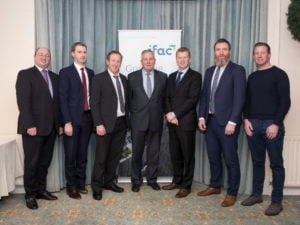
[caption id="attachment_260246" align="alignleft" width="300"] Shane Harrington(IFAC Development Manager), Shane Delaney(IFAC Partner, Portlaois), Billy Holland(IFAC Partner, Portlaoise), Sean Clarke(IFAC Chair), James Kelly(Irish Farmers Association), Gareth Hayes(IFAC Financial Planning, Head Office, Dublin) and Lorcan Allen(Farmers Journal) pictured at a Farmers Seminar "2019 and Beyond" organised by Ifac, the farming, food and agribusiness professional services firm a farming seminar in conjunction with The Irish Farmers Association and The Farmers Journal in The Keadeen Hotel, Newbridge. The event was held on Monday 26th November, at 8pm. Photo:Michael Donnelly.[/caption]
2.