

Kildare secondary school named Ireland's fittest school after taking part in national fitness challenge
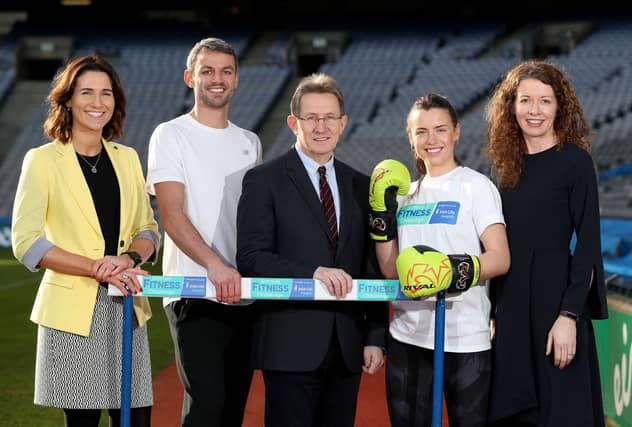

Pictured at Croke Park at the awards ceremony yesterday are Irish Life Health ambassadors: Thomas Barr, Mary-Kate Slattery, Prof. Niall Moyna and Dr. Sarah Kelly
By Kim O'Leary
St Mary's College (Colaiste Naomh Mhuire) in Naas, Co. Kildare, is the overall winner of ‘Ireland’s Fittest School’ in the Irish Life Health Schools’ Fitness Challenge, and has also been named ‘Ireland’s Fittest Girls’ School’ in an awards ceremony held in Dublin yesterday.
Now in its eighth year, over 200,000 students have participated in the Irish Life Health Schools’ Fitness Challenge making it the largest national multi-year surveillance study on the fitness of secondary school children in Ireland.
Irish Life Health Schools’ Fitness Challenge focuses on preventive and proactive healthcare. It shows that small steps through a six-week fitness programme can make real, impactful changes through increasing fitness levels by an average of 10%.
Results released yesterday from the Irish Life Health Schools’ Fitness Challenge 2018, reveal that participation in the fitness challenge drops by over 80% after third-year and the fitness levels among girls decreases dramatically from first to sixth year.
The Irish Life Health Schools’ Fitness Challenge demonstrates that a six-week fitness programme improves children’s fitness levels by an average of 10%.
Prof. Niall Moyna, who oversees the programme, in the Centre for Preventive Medicine at Dublin City University said, “The past seven years of data have enabled us to analyse the trends and of biggest concern is the tremendously large participation drop off after third year.”
The 2018 data shows that nearly nine-thousand 13-year-olds participated in the Schools’ Fitness Challenge compared to a meagre thirteen-hundred 17-year olds.
Prof. Moyna continued, “The sudden drop in participation after third year is extremely alarming. We are seeing a direct link between the drop in participation and the increasing number of children aged from 16 – 18 years not meeting the minimum level of fitness required for optimal health. This is a major national issue, and the big question is why are schools and parents letting this happen? Instead of managing health implications as they arise, we should be trying to prevent them. In addition to be the leading cause of death in Ireland, cardiovascular disease is also associated with increased risk for dementia and parents just don’t seem to get the connection between childhood fitness and long-term health.”
Commenting on the link between exercise and academic performance, Prof. Moyna said, “It continues to baffle me that people don’t seem to understand the importance fitness has for children’s long-term brain health and short-term wellbeing and academic performance. There are several international studies which show that exercise helps reduce stress levels, increases concentration levels and positively impacts on academic performance. Findings from a 2014 study that tracked over 80,000 students found that children who significantly improved their fitness over a 5-year period enhanced their academic performance compared to children whose fitness levels did not change2. I think continuous surveillance of cardiorespiratory fitness should be mandatory in secondary school.”
Liz Rowen, Head of Marketing at Irish Life Health said, “The Irish Life Health Schools’ Fitness Challenge is core to our values of early health intervention and encouraging people to live a long and healthy life. It has been proven that health behaviours adopted in your teenage years reflects directly on how fit and healthy you are later in life which is why we are so passionate about this programme. We are proud to be working with DCU for the 8th year to help encourage children to incorporate fitness into their everyday routines.”
Irish Olympian and Irish Life Health Ambassador, Thomas Barr said, “The Irish Life Health School’s Fitness Challenge is something all schools across the country should be taking part in. The benefits children can gain from just a six-week programme are astonishing. I’ve always been a big advocate for encouraging children to partake in regular fitness as I know first-hand the benefits it has on my own physical and mental health. There is nothing that clears my head better than a walk or fitness session.”