

Kildare's Wildlife Watch: Comfrey for easing aches and feeding gardens

With the Irish Peatland Conservation Centre
The benefits we receive from nature are known as ecosystem services. Ecosystem services can be divided into four categories — provisioning, regulating, cultural and supporting.
We are all familiar with the first service, provisioning, as it is often the concrete service we receive from nature.
For example, bees give us honey and pollinate our crops for food production, trees provide wood for building materials and fuel, extracts from plants provide medicine such as digitalis from the foxglove to treat heart failure.
Culturally nature offers us recreation opportunities and inspire artists and poets.
Nature regulates our environment through carbon, nutrient and water cycles and in its supporting role nature provides biodiversity and pest and disease control.
One plant, which was probably introduced to Ireland rather than being native, is comfrey (compar as Gaeilge). It is an example of how plants offer us a service.
Traditionally, comfrey was used to treat arthritis, while today its value is recognised as a nitrogen rich additive to our compost heaps or indeed to make a nutrient rich organic liquid feed for our gardens.
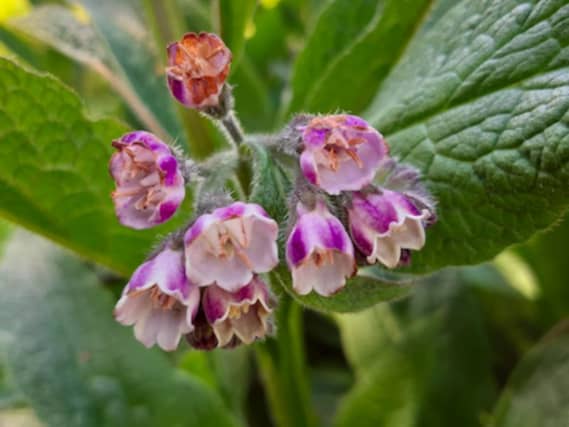
Comfrey is in flower now, and I photographed this plant in the wildlife gardens at the Irish Peatland Conservation Centre last week.
The flowers grow in clusters, are bell shaped and can range in colour from pink, purple to white. The lower leaves of the plant are oval-lanceolate (the leaves are longer than wide and pointed) in shape while the upper leaves on the plant are oval. The leaves and stems are covered in tiny hairs and comfrey can grow to a height of 1.5 metres.
The roots are known to be deep and it is believed these deep roots support the plant in absorbing nutrients most other plants cannot reach, thus allowing the plant be very nitrogen rich but also support and stablise the plant’s height.
Comfrey can be found growing on waste ground, grasslands, river banks and wild gardens — will you find this plant in your community this week?
If you would like help identifying local wildlife or indeed to share your images of local wildlife encountered to be used in a future Wildlife Watch, contact me on 045 860133 or email [email protected].