

Kildare's Wildlife Watch: Keeping count of our Marsh Fritillary nests

With the Irish Peatland Conservation Council
Fieldwork is plentiful in summer, as we complete both habitat research and species monitoring.
Autumn is usually the time of year when report writing begins but each year one final field based research project is undertaken, the Marsh Fritillary butterfly nest count.
The Marsh Fritillary is one of Europe’s most threatened butterflies and is listed as an Annex II species in the European Unions Habitat and Species Directive.
Lullymore West Nature Reserve in Co Kildare has a resident population of this butterfly. While the site is managed for all butterflies, and monitoring of all butterflies is undertaken from April to September, it is only for the Marsh Fritillary that a larval nest count is completed.
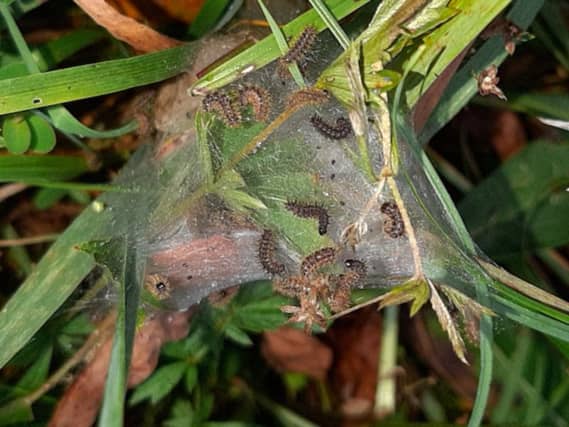
At this time of year, the caterpillars are smaller than a tic tac but they do live in communal protective webs, so although they are small, living together can make them easier to find.
Why is it important to monitor the nests of this particular butterfly?
During the summer, the adult Marsh Fritillary are recorded on the wing, but to record expected populations for the following year, a nest count in autumn is required.
If no nests are found, it would provide early indications that this threatened butterfly has experienced some type of environmental change.
With the support of a team of volunteers, this year 18 Marsh Fritillary larval nests were recorded on the reserve.
The tiny caterpillars observed were busy feeding on their food plant Devil’s Bit Scabious. Over the next few weeks they will spin a dense web to protect them over the cold winter months ahead.
In spring, the caterpillars will emerge and a second larval nest count will be completed.
Although not necessary, the purpose of the second count in spring allows us to record if nests have been lost over the winter and indeed, as the caterpillars are larger, it gives us an opportunity to identify nests that may have been missed during the autumn nest survey.
If you would like help identifying local wildlife or indeed to share your images of local wildlife encountered to be used in a future Wildlife Watch, contact me on 045 860133 or [email protected].