

Kildare's Wildlife Watch: The rich and international history of rushes

With the Bog of Allen Nature Centre
The start of February is an important time in our calendar year. While, meteorologically, March 1 is the start of spring, in the Gaelic calendar the first of February is traditionally the start of spring. It is also the day we celebrate St Brigid’s Day.
Many of you will be familiar that, annually on this date, St Brigid’s crosses are made and placed in our homes to protect them against fire and infectious diseases.
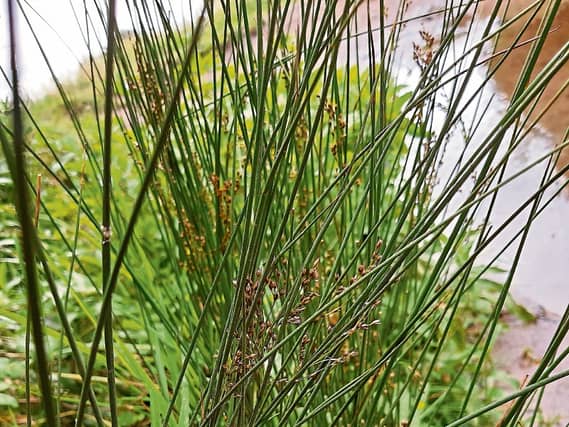
The crosses are made from rushes (geataire as Gaeilge) which can be found growing in wet ground including cut boglands, fields, road side verges and water edges.
They grow in tufts that can measure up to 100cm high. The long stems are glossy green, spherical, evergreen and smooth to the touch but internally are ridged.
There are a number of varieties of rushes and around the world they have been used for many different purposes.
In medieval Europe, it is said rushes were used on floors for insulation. In Japan, rush species were weaved to make mats and indigenous Australians used them to make baskets and fibres for string and fishing line.
The Irish Peatland Conservation Council have a short video and instructions available on our website, www.ipcc.ie, if you would like a guide to make your own St Brigid’s cross.
February 2 marked World Wetlands Day. This is an internationally recognised day to encourage community members to take action for wetlands and it also marked the annual launch of Ireland’s Hop to It Frog Survey.
This citizen science survey asks you to report your sightings of the various stages of the common frog.
The common frog is a species that helps indicate changes in our environmental quality and tracking and recording their populations changes supports understanding our environment. It is easy to get involved — simply submit your frog sighting at www.ipcc.ie/help-ipcc/ hop-to-it-national-frogsurvey- irelandcard.
I encourage you all this week to get out and discover your local wildlife this week and don’t forget if you come across a wildlife species that you would like help identifying I would be happy to help. Contact me at [email protected].