

OPINION: Kildare is facing a population explosion and will struggle to cope

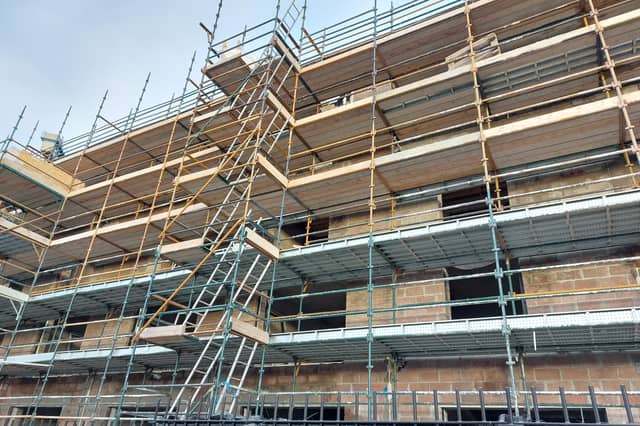

By 2031, Kildare’s likely population figure could exceed 270,000.
There’s a scene in the award winning film No Country For Old Men, depicting a drug deal that's gone well wrong. Dead bodies, guns, burnt out vehicles, litter the desert. Two cops survey what's happened.
“It’s a mess, ain’t it Sheriff ?,” says one.
“If it ain’t, it’ll do till the mess gets here,” comes the reply.
There are rising fears about the ability of County Kildare to properly absorb a substantial population increase.
And there is deep disquiet among locally elected politicians over how the county can cope with significant additional residential development.
Many have been expressing concern for some time about whether the facilities and amenities are available - or can be provided - to cater for a big jump in the number of residents.
The population of County Kildare was 247,774, according to the 2022 census.
Kildare occupies seventh place on the most populous counties list, behind Dublin, Cork, Antrim, Derry and Galway - each of which has a city.
The number of people living in Kildare rose by 11.9% between 2016 and 2022. This was more than Dublin, Antrim, Cork, Galway or Derry.
Only one county, Meath (12.9%) saw a bigger increase. That’s apart from Longford (14.1%), which has just 46,751 residents in 2022 - and Longford’s population is less than Naas and Newbridge combined.
By 2031, Kildare’s likely population figure could exceed 270,000.
The Kildare County Development Plan for 2023-2029 is not an easy read and won't top the best sellers list; but it’s worth a look and ought to be available in your local library. It runs to 609 pages with a three page index. It took two years and three periods of public consultation.
We, the public, were invited to attend workshops, make submissions and listen to podcasts. It couldn’t be a more transparent all-embracing process.
It sets out the effort to provide housing, amenities including services and transport. It structures proper planning and sustainable development across the county and seeks to address the news of the community - physical, economic, social and environmental.
But now, after all of this work, the 40 councillors on Kildare County Council are being asked to revisit this document to allow for even more residential development - this in a county that has already seen a disproportionately high level of growth.
What, you may inquire, is the point of putting so much work into this document only to have it altered.
The answer to that is the housing crisis.
Just as the most recent government answer to the housing crisis is to build “shoebox” apartments.
But there has to be more than just housing units. Residents of many towns across the county are aware of the daily congestion on the roads. And while our roads and streets and motorway ramps are choked with the traffic the alternatives - adequate bus and train services - are not there in sufficient quantity or quality.
As ever, infrastructure lags well behind. The housing mushrooms almost overnight, but the schools, creches, medical facilities are not there.
Plans for cycle lanes and bus lanes on the Dublin Road in Naas were drawn up well over eight years ago, but construction work has yet to start, a shovel has yet to hit the ground. That kind of timeframe would facilitate the construction of towns full of apartments.
Equally there are plans for infrastructure including a bridge link to the Millennium Park area in Naas, a relief road connecting Dublin Road and Blessington Road in Naas and a bridge over the River Liffey. But when ?
The M7/N7 route to and from Dublin is congested daily and the M50 is little more than a car park at times - yet the bus service is inadequate both within the county and in terms of connections to towns elsewhere. Many bus stops have no basic shelters, as if we lived in Spain, and Kildare's residents often stand in the mud for a bus that may be late or not even show.
Kildare County Council’s officials give long monotonous accounts about efforts to deal with climate change and the need to adapt - while a short few miles down the road people stand in the winter mud and rain waiting for a bus that’s likely running late at a stop with no shelter. As if we lived in a country with all year round sun.
Despite issues with water supply and frequent loss of supply, KCC approved a data centre in Naas – a decision that’s been appealed.
Cllr Evie Sammon has said trains are passing through Sallins station leaving passengers on the platform - because they are full.
Sports clubs are under pressure. Colm Kenny, a former Naas councillor, was among a delegation that came to a county council meeting to make the case for a permanent base for a basketball club in the town. The club is 30 years old and has 350 members across all age groups.
It’s not alone in having poor or no facilities.
Independent councillor Seamie Moore has made the point that while lands are zoned for recreation purposes, it doesn’t mean much if the sports fields and buildings don’t follow.
He has said that the social and sporting infrastructure is inadequate despite the increase in population that has already taken place, not to mind what may be coming and he predicted “explosive” population growth.
In Sallins, the wait for a community park has run into 11 years, while the houses and apartments appear almost overnight.
Sallins has a population of about 7,000 - but no secondary school. Towns with smaller populations around Ireland have a secondary school.
Cllr Bill Clear says that the primary school in Sallins is also full.
He also believes that another second level school is needed in Naas. There are no immediate plans to bring about any of these.
A new second level school is "desperately needed” in Naas, according to Cllr Clear who said that every existing school is full.
“Naas is one of the fastest growing areas in Ireland (and) another school is desperately needed,” he said.
Automatic school places are being denied to some children across County Kildare.
There is anecdotal evidence that parents cannot find places for children in primary schools in larger towns and are trying to get them enrolled in neighboring villages or towns.
There are three government TDs and an education minister - James Lawless, Naoise Ó Cearúil and Joe Neville - in the Kildare North constituency, where a school closed temporarily because of safety concerns in a country awash with tax revenue. One of them (Dep Ó Cearúil) suggested moving prefab structures from another town to deal with the problem.
According to TD Aidan Farrelly, pupils and students seeking admission to both primary and post primary schools are being affected.
Dep Farrelly says Kildare has the highest average class sizes in Ireland. “Children are being crammed into classrooms of 30 or more, while the government points to national averages that hide these pressures. Parents and teachers are doing the heavy lifting as the government sits on the sidelines. This is unacceptable, and it shows that the system is failing children.”
A group of primary pupils are without a school place in Naas because of a teacher shortage.
A group of 25 junior infants pupils due to enrol in St Corban’s Boys National School in Naas this year have no teacher.
Parents are being asked to contact both government ministers in Kildare - Sallins resident James Lawless and Martin Heydon, who represent the Kildare North and Kildare South constituencies respectively as TDs.
According to the school a "junior infant places crisis” developed earlier this year which meant 20-30 children would not have a place for next year.
The Department of Education asked the school to enrol an extra junior infants class (three instead of two) to solve this
A new €15m school is coming to Prosperous, following the granting of planning permission in December 2024.
But Cllr Paula Mulroe said it will be at capacity in three or four years and “we’ll find ourselves looking for temporary accommodation around 2030.”
Dep Ó Cearúil said social infrastructure is not keeping pace with new homes being built. He said in Maynooth, Celbridge, Leixlip, Clane, Kilcock, Naas and Prosperous "and every other town in the (Kildare North) constituency, children are not guaranteed a secondary school place.”
Kildare councillors recently came out against the plans to approve smaller apartments and there are concerns that infrastructure to process water and sewage is not adequate.
Bizarrely, it now seems that an unforeseen set of circumstances may put a dampener on plans to build much smaller apartments with less natural light.
Dr Alan Ahearne, the respected economist who, along with David McWilliams, foresaw the last economic crash, believes that a shortage of labour may slow down plans to build up to 83,000 housing units a year.
In the Sunday Independent recently, he said the last building spree was facilitated by an influx of labour from eastern Europe, which is no longer available.
“Those builders are in Poland where wages have risen, they’ve got plenty of work,” said in the Sunday Independent interview.
A new town should be developed in County Kildare, says Cllr Moore.
The creation of Shannon, County Clare, is the foremost example of Ireland's first planned town and more recently the term has been used to describe Clonburris in south Dublin and Seven Mills between Clondalkin and Lucan, which are being built.
He wants a new town to be created in mid-Kildare between Naas and Newbridge along with a corridor in the same area which would stimulate economic activity.
He wants this to be part of the National Development Plan and he is seeking support for this from fellow councillors. Cllr Moore also wants the Eastern and Midland Regional Assembly, which promotes sustainable development, to consider the idea.
He said the town should be developed along the catchment of the M7 and M9 motorways, near the rail line between Dublin and Cork “on an axis between Kilcullen and Rathangan.”
He said a new town will ease the pressures likely to be created as the populations of Naas and Newbridge expand.
He added it would also allow necessary amenities and infrastructure to be developed in Naas and Newbridge which he said are “already overpopulated towns.”
Cllr Moore told a KCC meeting that the social and sporting infrastructure in Kildare is inadequate despite a huge increase in population.
He said government support is needed to provide amenities for the very many people who may come to live in Kildare over the coming years.
“The existing support is provided on a piecemeal basis (and there will be) explosive population growth,” he said.
Recent trends suggest growth may reach the higher end of forecasts.
The population has already increased partly because of the number of Strategic Housing Developments that took place across the county, notably in Naas, Clane, Newbridge, Kilcock, Maynooth and Kill in recent times.
SHDs were a national initiative which allowed developers to seek planning permission for building 100 or more houses from An Bord Pleanála (now an Comisiún Pleanála) rather than local authorities like Kildare County Council.
The initiative aimed to accelerate housing delivery and, in some cases, resulted in developments that exceeded targets outlined in Local Area Plans. However, it also attracted criticism - particularly around the mismatch between residential growth and public service provision - and faced legal challenges. The legislation enabling SHDs has since been repealed.
While recently revised land zoning targets now allow for higher levels of population growth, questions remain as to whether rising development costs and the capacity limitations of the construction sector will significantly affect the delivery of planned and serviced housing.
Fine Gael councillor Kevin Duffy said a lot of population growth is coming and KCC must look at where in the county it is likely to take place over the next 20-25 years.
Referring to demand for housing, Cllr Noel Heavey said there is “very severe pressure” in Newbridge and said the availability of land and resources need to be examined.
He said planning should be done in advance “rather than reacting to pressure points.”
Cllr Pádraig McEvoy said there will be concerns over the capacity of rivers to absorb additional waste water created by more new development.
Cllr Chris Pender said he supported the concept of a new town.
And, with admirable candour, added “without knowing where it should go”.
If it’s not a mess, it’ll do until one arrives.