

Princess Diana's wedding dress 'prototype' on display in Newbridge

Princess Diana died on the 31st August 1997 when she was just 36 years old making this year the 20th anniversary of her death.
To remember her life in style and fashion, Newbridge Silverware and the Museum of Style Icons will host a new exhibition showcasing some of the Princess’ most famous garments and personal effects.
‘Diana – A Fashion Legacy’ runs from 31st of July – 30th of September and is free of charge.
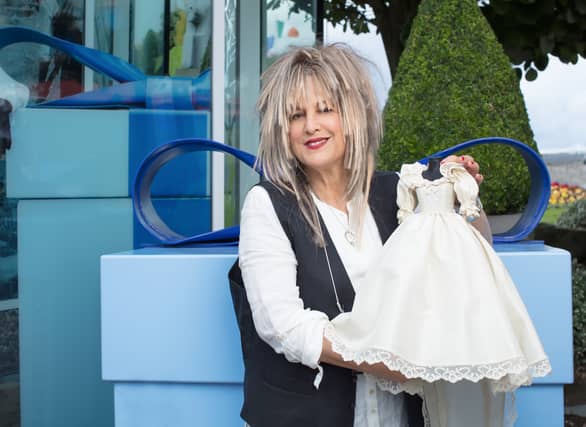
On display will be Princess Diana’s most famous outfits including the original toile of her wedding dress, co designed and created by Elizabeth Emanuel who officially opened the exhibition today.
This was a huge undertaking at the time as the Princess was one of the most photographed, if not the most photographed woman in the world.
In an age before Instagram and social media the allure and style of Princess Diana still made its way across the world with every outfit she wore being scrutinised and admired. Naturally then, the wedding was a huge affair and was televised with an estimated 700 million people worldwide tuning in to see ‘the dress’.
Of course, it didn’t disappoint – it was made of ivory silk, pure taffeta and incorporated antique lace, 10,000 pearls and had a 25ft train.
The exhibition at Newbridge Silverware includes the final calico toile for the royal wedding gown and a replacement veil. A toile is a dressmaker’s equivalent of a working document, this toile, which was made by the Emanuel’s was a pre-cursor to Diana’s actual wedding dress, in other words, the final fitting toile of her wedding gown which was later made in silk and features the same details, including the flounced cuffs and trained skirt. The designers made this toile to allow them to adjust the sizing and it has a distinctive shoe mark on the inside of the dress.
Numerous bodice changes had to be made by David and Elizabeth Emanuel as Diana continued to lose weight in the weeks leading up to the wedding day. “Diana, like many nervous brides, must have lost about a stone and a half in weight during the run-up to the wedding,” said Elizabeth Emanuel. “The actual gown was only made up in silk based on this final toile at the last possible moment to ensure the most accurate fit and as there was a limited amount of the specially woven silk available”
After the dress was made, some silk was left over and the Emanuel’s made a miniature copy of the royal wedding gown and bridesmaid dresses (similar to the ones given to Princess Diana by Elizabeth Emanuel and David Emanuel in 1981). The miniatures were made at a scale of 1/8th of the original dress and were created using cut-offs from the original bridal silk and lace, mounted onto miniature mannequins. The miniatures are also on display at the exhibition at Newbridge Silverware and feature mini versions of the three bridesmaid dresses similar to those worn by India Hicks, Clementine Hambro and Lady Sarah Armstrong Jones.
In her book, ‘A Dress for Diana’ which has just been re- released, Elizabeth Emanuel said, “We believe Diana chose us because the feel of Emanuel at the time was soft, pretty, romantic and very importantly youthful. But we knew that the dress we would create for her would also need to be grand enough to be a part of history. The prospect of designing the gown, though exciting, was also quite daunting. We didn't have any experience in designing royal wedding dresses. The extraordinary thing was that we weren't given any restrictions by the palace. There was no protocol. There wasn't even anything to say the dress had to be white. In the end, the design process was quite simple because there were just the three of us: David, Elizabeth and Diana. We began by showing Diana all the dresses that we had samples of and we encouraged her to try them all on so that she could get an idea of what she felt comfortable in. She had never really worn anything quite like this kind of dress, so it was important for her to try on every single shape we had. She was terribly excited to be trying on huge bouffant petticoats, satin skirts and boned bodices, and she loved every minute of it.” The excitement and interest in the dress and its design was so intense that the designers had to fit a safe into the studio where the designs and drawings for the dress were safely locked away each evening, safe from the prying eyes of the press who had camped outside their studio.
Other items linked to Princess Diana and Elizabeth Emanuel which are on show at the exhibition include a leather bound album relating to the Royal Wedding in 1981, including the Royal Wedding Order of Service, ‘Ceremonial’ invitations to ‘Mr and Mrs D Emanuel’ to both the wedding and reception, passes, seat reservations, press clippings, photographs and souvenirs to the wedding. There is also an album of press clippings which include letters, written by the Princess. Separately, Christmas cards, handwritten by the Princess to friends and family are also on display in the exhibition.
Even though it is now almost twenty years since the Princess of Wales died, the public interest in her, her style and persona has never diminished. In her short life, Princess Diana became a style icon, admired around the world for her grace, beauty and impeccable taste. Unlike many women today who are regarded as ‘style icon’s’ there is not a single item or specific look that sums up Diana and her style. She was a modern royal, a woman who broke the mould and was as happy in a black-tie gala dress as she was in jeans and a sweater which she often wore while playing with her young children.
Her pre-wedding style was defined in her early years by frills, bows and whimsical details. It was a romantic and innocent look which was far removed from her later styles which at times were sexy, sporty and even androgynous. Diana was a chameleon who understood fashion and the power of clothes and used clothes to communicate her mood and frame of mind.
As a public figure who embodied glamour, intrigue, duty and mystery, Diana's wardrobe was one of her most powerful tools of communication. "She was always very thoughtful about how her clothes would be interpreted, it was something that really mattered to her," said Anna Harvey, Vogue’s former deputy editor. On the night that Prince Charles admitted his infidelity in 1994 Princess Diana wore a sexy, black off the shoulder dress by Christina Stambolian. The figure hugging dress, with its split up the leg showed off her toned figure and athletic body and was a regarded by many as a strategic dress, worn by the Princess to tell her wayward husband that she was strong and determined and would not be put down by his infidelity. The plan worked and the next day’s papers showed pictures of a confident, beaming Diana arriving to the Serpentine Gallery in what would later became known as ‘The Revenge Dress’. This dress is probably one of the most important garments in the Princess Diana collection at Newbridge Silverware and marks a major turning point in her life. Composed of black silk damask, the bodice is crossed with tiny pleats which continue over the dropped shoulder line. A figure hugging gown with diagonally swathed chiffon skirt, which culminates in the trailing side swag.
Another important piece in the exhibition is the Catherine Walker Mughal-inspired lavishly embroidered pink silk evening gown and bolero, made for the state visit to India, in February 1992. It was during the state visit to India that Diana was famously photographed sitting alone at the Taj Mahal – the monument to lost love, which caused a good deal of comment and speculation in the press at the time. Her official separation from Prince Charles was to be announced in December of the same year. The Princess was photographed wearing this gown by Lord Snowdon in 1997 and is one of the most lavish of all her gowns. Labelled ‘Catherine Walker, London’, the sleeveless gown with deep scooped neckline and long princess-line bodice is delicately embroidered to the dropped waistline. It has three dimensional exotic blooms in looped and satin stitched silk, layered pink sequins, centred by amber, green and pink crystal beads and is scattered with small white floral shaped sequins against a green iridescent sequined background with gold chain stitched leaves. The bolero jacket is embroidered front and back and is lined with ivory satin. The plain silk cuffs each have three large buttons inset with emerald and pink rhinestones.
For more see www.newbridgesilverware.com or call (045) 431301.