

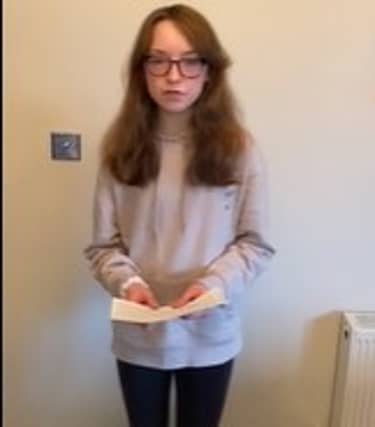


Eleven projects from County Kildare schools have been selected to appear in this year’s BT Young Scientist & Technology Exhibition 2022 (BTYSTE ‘22).
The annual competition will run from Wednesday, January 12 until Friday, January 14. The competition will be held virtually again this year, due to Covid-19 restrictions. Members of the public can view the exhibition this week at www.btyoungscientist.com.
Deciphering Dyslexia: a study in orthographic processing
St Wolstan’s Community School, Celbridge
According to the group, made up of TY students Rachel McMahon, Maja Wirkus and Charlotte Stevens (pictured above) and overseen by teachers Mr Kiely and Ms Delaney: “The purpose of our project is to investigate the different ways dyslexic people process words in comparison to non-dyslexic people.
The Truth Of Knowledge
Overseen by their teacher Ms Ward, students Cathy Manning and Orla Glennon (pictured above) explained: “Our project, The Truth of Knowledge, aims to find out where young people get their information; if there are external factors contributing to people falling for false information, for example age and gender; if young people are aware of the necessity of using reliable sources, and more. We used voluntary surveys to gather our results.
“We wish to investigate where young people get their information and if this influences whether they believe it or not. We want to find out if young people are aware of the credibility of the sources they use to find their information.”
They continued: “We hope to find out if they fact check the information they find, to ensure it is true. We have seen many people believe the first thing they see, hear, or read.
“We aim to find out if these sources can be trusted and if young people are aware of this. There is far too much misinformation and fake news all around us, and we wish to draw attention to this matter.
“We also want to know if where young people get their information influences whether they believe it, for example, from a celebrity, on social media, or in a news article. We also wanted to find out if your age or gender effects your likelihood to fall for false information.”
To Investigate if Honey has Antibacterial Properties
Overseen by their teacher Ms Kirrane, students Maisy Brady, Aoibhe Kerins and Eve Byrne (pictured above) explained: “It is a long held belief that honey has medicinal properties and we want to put truth to that belief.
“We covered sterile agar plates in a bacteria called e-coli, then created a well in the centre and put the honey in using a dropper. We left them in an incubator for 48hrs at 37°C and when we took them out we could see a zone of inhibition where bacteria didn’t grow as a result of the honey.
“It is true, honey does have antibacterial properties. So now when you’re not feeling well the best thing to soothe a sore throat is a spoon of honey.”
Canine Colour Psychology; an investigation into whether a dog’s colour preferences are influenced by the time of the day
Clongowes Wood College, Clane
Speaking on the project, Clongowes Wood said: “It is with delight to the science department and the Clongowes Wood College school community that we congratulate Third Year Student Tom Groome (above) and his teacher Ms Yvonne Nolan on his project being accepted to this year’s BT Young Scientist and Technology Exhibition.
“Tom’s project, Canine Colour Psychology; an investigation into whether a dog’s colour preference is influenced by the time of the day, will be judged in the Intermediate Biological and Ecological Category of this year’s exhibition.
Explaining his project, Tom said: “My investigation started simply based on my own observation of my pet dog Eric. I wondered if the belief that dogs are colour blind is actually true! I asked that simple question as a classroom-based assessment in second year.
“With encouragement from my teacher, I decided to extend my study and enter the BT Young Scientist and Technology Exhibition."
He continued: “Previously, I believed that dogs are colour blind, that they see the world in black and white. In fact, dogs are dichromatic.
“While humans have three types of cones, which detect colour, dogs only have two. I think I have discovered something useful!
RecycleWise
St Mary’s College, Naas
Aoibhe McKevitt and Aisling Reilly, fourth year students at St Mary’s, Naas, will be showcasing their project RecycleWise.
The development of a cost effective add on to enable all whiteboards to be interactive
Can a man’s best friend identify their owners’ different emotions?
Rozeta Leci’s (pictured above) project gets straight to the point in asking a very important question: can a man’s best friend identify their owners’ different emotions? Rozeta is a fourth year student at St Mary’s College, Naas. Teachers Nadine Hennessy and Naoise Gallagher supervised all three St Mary’s projects.
Acid Rain/Superabsorbent Polymer Crystals
Newbridge College
First year student Rían Hearne, under the supervision of his teacher Ann Marie Davis, is the school’s entrant for this year.
“Polymer beads were also used in both the petri dishes and in pots to see how it could impact the growth. In the petri dishes, it was found that the polymer beads hindered growth, while in the field trials with the pots, when the beads were mixed into the soil, it aided the growing plants by releasing the water slowly over time.
Uscalt.com: Developing an Open Data Ecosystem
Patrician Secondary School, Newbridge
Supervised by science teacher Colin Doheny, sixth year students Fintan Lawlor and Justin Cunningham (pictured above) detailed that their project explores data and data retention in the context of research.
Justin explained: “We set out to let users control what data is collected off them, and shared with other people online, and instead getting more data into the hands of academic researchers to open up new fields of research and technology.”
Fintan added: “We have been working on this since February of last year, after the previous Young Scientist. We had very little to do in lockdown, so we decided to have another try at it.
“According to a computer science academic study, an American family of four can generate up to €17,000 worth of data per year, through using their devices.”
When asked about their chances of winning, Justin said: “The experience of doing the BTYSTE is enough, but if you can win, that would be great too.”
Fintan also replied: “Whether or not we do well is up to the judges, but we’re happy with what we built.”
Explaining and simplifying the Covid-19 vaccine
Cross And Passion College, Kilcullen
Explaining their project, students Charlotte Darby and Emma Cremin said: "We’re using our project to better simplify and explain the COVID-19 vaccine for teens, as we believe that the HSE’s explanation is far too complicated."
1.
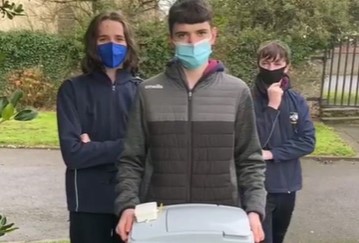
Supervised by teacher Amy Sullivan, students Daire Phelan, Gabriel Polland-Curran and Peter Burke question if people will prefer to put their waist in a normal bin or an exotic singing bin.