

Angry scenes as hundreds protest over Kildare data centre plans

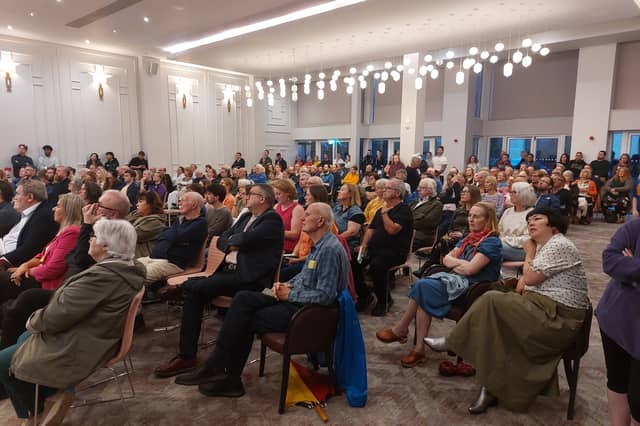

Concerns were expressed about the quantities of electricity and water the centres will consume
Over 300 residents turned up for a public meeting to demonstrate their opposition to data centres in Naas.
By the time the event got underway in the town’s Osprey Hotel, there was standing room only.
Organised by the recently formed Kildare Data Centre Awareness Campaign, the meeting heard repeated criticism of Kildare County Council for granting permission to Herbata Ltd for a €3 billion data centre campus in the townlands of Halverstown, Jigginstown and Newhall, near the M7 business park.
There were heated scenes as some of those present criticised councillors and KCC.
That decision, which gave the green light to six two-storey buildings, has been appealed to An Coimisiún Pleanála, the planning appeals body formerly known at An Bord Pleanála - by its opponents as well as the developer, who is unhappy at some planning conditions.
The group is also pressing to have a piece of land at Jigginstown, near the Primrose Garden residential area, rezoned so that it cannot be used to develop another data centre.
The KDCAC is also campaigning for a moratorium on the creation of any new data centres.
The meeting also heard criticism of local politicians, especially councillors.
A number of politicians, TDs and councillors, were present but only two - Independent Ireland councillor Bill Clear, who lives in Naas and Sinn Féin TD Réada Cronin - addressed the meeting.
KDCAC’s Krystle Foley said the growth in data centres had caused considerable increases in electricity bills for ordinary people and, because of the presence of high tech companies in Ireland, it had become a “home for data centres."
Ms Foley also pointed to noise emanating from the centers which she likened to “high pitched howling or a distant siren.”
She added that the noise can be heard 2 kms away from some centres.
She also said the Herbata project will need enough electricity to power 360,000 homes.
Clyde Doyle of KDCAC said 90% of centres in Dublin are in economically deprived areas.
Naas resident and head of advocacy at An Taisce’s Dr Elaine McGoff claimed the emissions from the Herbata campus will be greater than indicated and the campus will take electricity from the grid - only using the planned gas turbine as back up.
Dr Mc Goff said the centres are "incredibly thirsty” and water is needed for cooling or they won’t function.
She also claimed that “we’re not getting accurate figures for water usage", adding that water cooling will be needed in the summer months when temperatures reach 25 degrees.
Dr McGoff said water will be taken by the centre in the summer months “when the temperature is high and there are water shortages."
She pointed out that Uisce Éireann objected to housing development in Dunsink, Dublin, because the wafer supply is inadequate “yet they're supplying water to data centres in the area.”
Dr McGoff said there are communities in the US where wells are running dry because of the centres.
She also said the requirement that 48 hours worth of rainwater be stored by Herbarta “wouldn’t have lasted long this summer.”
She added: “Ireland is rapidly becoming the data centre capital of the world, but at what cost and who benefits ?.”
Another Naas resident and former councillor Sorcha O’Neill claimed two Naas councillors elected to serve the Naas area voted to zone the site near Primrose Garden for data centre use and five Naas councillors “motioned to increase the size of the zoning.”
Ms O’Neill said the land, previously owned by a farmer, was then sold to Microsoft, which she claimed, lobbied councillors to support the zoning needed - as it's allowed to.
“There are already concerns about water supply and reserving land for (increased) water usage looks hard to justify," Ms O'Neill said.
She also said the Jigginstown site is archeologically significant.
David Monaghan, a Sinn Féin representative in Sallins, said the centres used twice as much water this summer "when the public had a hosepipe ban.” He said the centres will be taking much more power by 2030.
Consultant geriatrician Colm Byrne said air pollution caused by gas turbines will impact cardiovascular health and raise the risk of stroke.
“We need to limit the amount of carbon we’re putting into the atmosphere.”
There was considerable applause when he said: “We need to stop building data centres."
Cllr Clear told of visiting a centre in Clondalkin where “you could smell it and hear the noise coming from it.”
Referring to previous decisions by councillors, he said that there is much more opposition to the centres today than when the first proposals for centres emerged.
Dep Cronin said Ireland’s electricity grid is like “a 30 year old banger on the road” and artificial intelligence has an "insatiable appetite for electricity.”
“We don’t have the climate for data centres; they should be located in colder countries,” added the TD.
Councillors will be pressed to remove land zoning before any more centres are built and not to zone any more land specifically for data centres across Kildare.
The KDCAC is also asking councillors to press for the suspension of any more centres until more is known about the cumulative impact on communities.